

60% of FLT3+ AML patients relapse despite available therapies
Acute Myeloid Leukemia (AML) remains one of the most lethal blood cancers, with a five-year survival rate below 30%. For patients carrying FLT3 mutations — representing a significant subset of all AML cases — more than 60% develop resistance to currently approved therapies and then die within less than six months. Despite recent advances in targeted treatment, no therapy directly addresses the convergent resistance mechanism: the oncogenic activity of STAT5. RIANA Therapeutics was founded to close this gap.
STAT5 drives resistance when leukemic cells escape standard of care treatments
We are developing selective small-molecule inhibitors that disrupt STAT5 oligomerization — the protein-protein interaction that drives AML resistance downstream of FLT3 and other oncogenic signals. Unlike kinase inhibitors that operate upstream, our mechanism targets the point at which resistance pathways converge, making it inherently harder for cancer cells to escape.
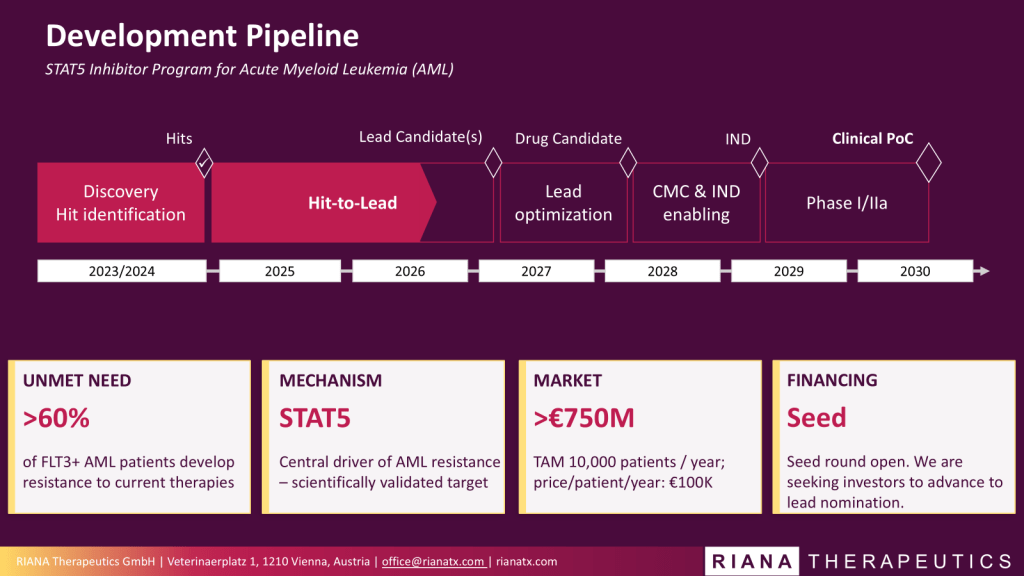
Roadmap:
2027 Lead ID
2028 Drug ID
2029 IND ready
2030 phase I/IIa
Having successfully completed hit identification in 2023–2024, we are currently advancing through the Hit-to-Lead stage. Our roadmap targets lead candidate nomination by 2027, drug candidate selection by 2028, IND-enabling studies through 2028–2029, and a Phase I/IIa clinical proof-of-concept study from 2029 onward.
Market opportunity
FLT3+ AML is an orphan disease and affects approximately 30,000 new patients per year. Considering every fourth patient can be treated, and at an estimated treatment cost of €100,000 per patient per year, the serviceable obtainable market (SOM) is €750 million annually — and grows substantially when considering the broader STAT5-driven oncology landscape beyond AML.
 RIANA Therapeutics