RIANA Therapeutics is currently raising a €2.5M seed round to advance our STAT5 inhibitor program to lead nomination. Having successfully secured Austrian non-dilutive public funding four times, we offer investors an unusually capital-efficient entry point: with co-financing rates of up to 60% at this stage, every euro invested carries the programmatic impact of two to three — without additional dilution. If you are an investor with an interest in early-stage oncology and first-in-class potential, we would welcome a conversation.
We are particularly interested in connecting with early-stage investors who bring not only capital but sector expertise — whether in oncology, drug discovery, or Austrian and European biotech ecosystems.
Ticket sizes starting at €100K are welcome at this stage. The round will be closed by November 2026.
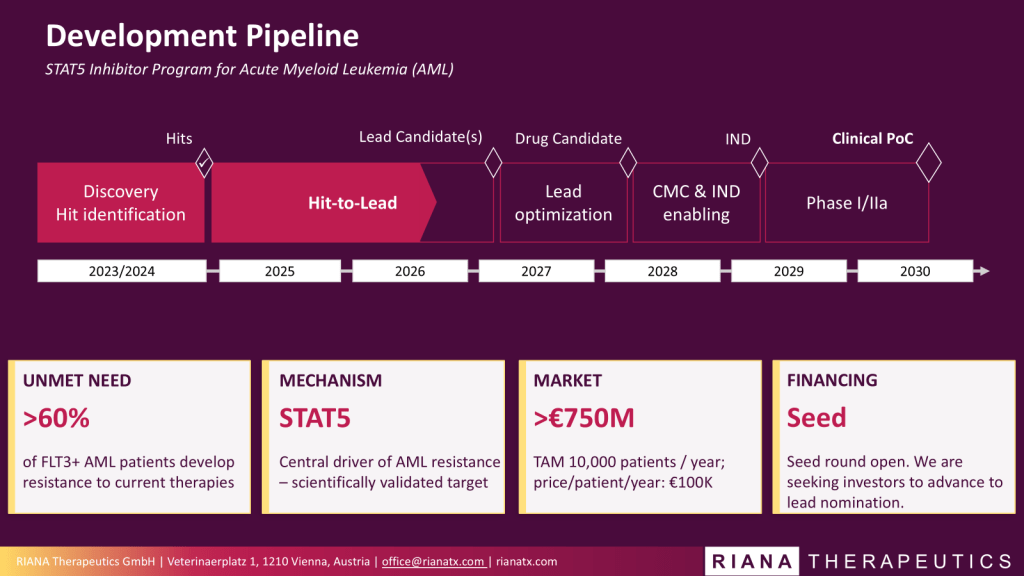
60% of FLT3+ AML patients relapse despite available therapies
Acute Myeloid Leukemia (AML) remains one of the most lethal blood cancers, with a five-year survival rate below 30%. For patients carrying FLT3 mutations — representing a significant subset of all AML cases — more than 60% develop resistance to currently approved therapies and then die within less than six months. Despite recent advances in targeted treatment, no therapy directly addresses the convergent resistance mechanism: the oncogenic activity of STAT5. RIANA Therapeutics was founded to close this gap.
STAT5 drives resistance when leukemic cells escape standard of care treatments
We are developing selective small-molecule inhibitors that disrupt STAT5 oligomerization — the protein-protein interaction that drives AML resistance downstream of FLT3 and other oncogenic signals. Unlike kinase inhibitors that operate upstream, our mechanism targets the point at which resistance pathways converge, making it inherently harder for cancer cells to escape.
Roadmap: 2027 Lead ID 2028 Drug ID 2029 IND ready 2030 phase I/IIa
Having successfully completed hit identification in 2023–2024, we are currently advancing through the Hit-to-Lead stage. Our roadmap targets lead candidate nomination by 2027, drug candidate selection by 2028, IND-enabling studies through 2028–2029, and a Phase I/IIa clinical proof-of-concept study from 2029 onward.
Market opportunity
FLT3+ AML is an orphan disease and affects approximately 30,000 new patients per year. Considering every fourth patient can be treated, and at an estimated treatment cost of €100,000 per patient per year, the serviceable obtainable market (SOM) is €750 million annually — and grows substantially when considering the broader STAT5-driven oncology landscape beyond AML.
ADRESSING HIGH POTENTIAL BUT CHALLENGING DRUG TARGETS
While the clinical success of tyrosine kinase inhibitors has validated the power of targeted therapies, numerous well-described oncogenic drivers are still not addressed by approved medicines. A key reason is their dependence on challenging protein–protein interactions (PPIs), which have historically been difficult to modulate with small molecules.
ULTRA-PRECISE TARGETING OF A DISEASE-DRIVING MECHANISM
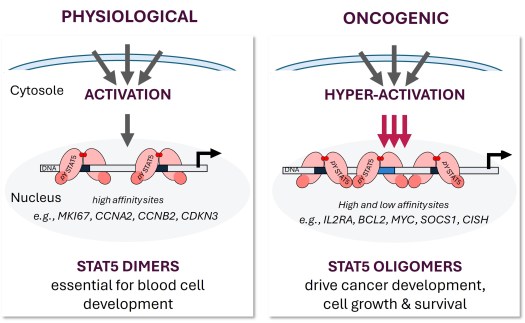
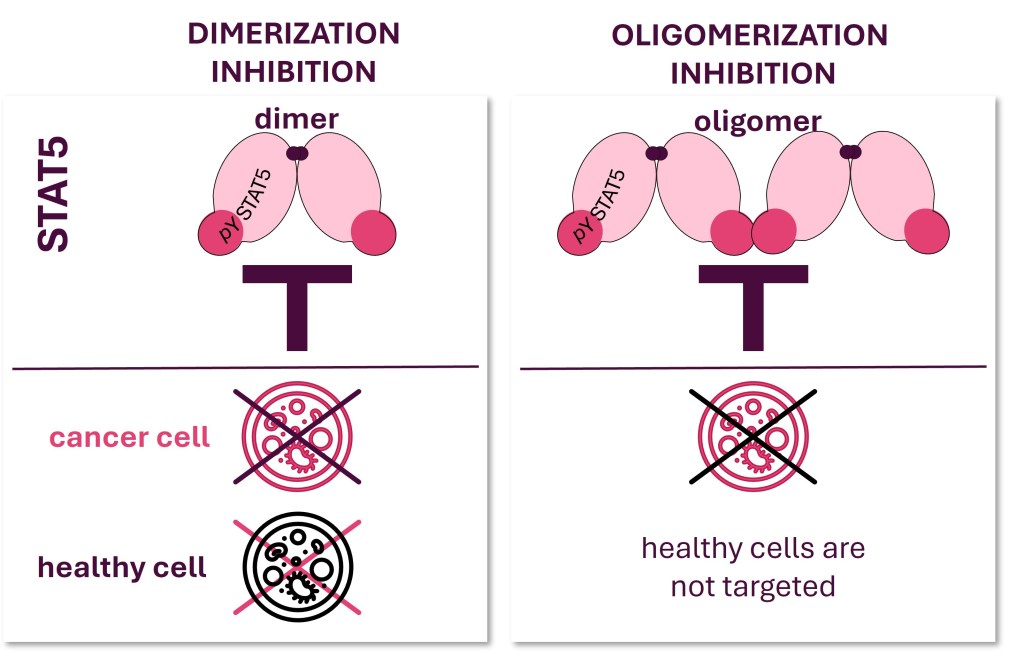
STAT5 is one such target. In hematologic malignancies, including acute myeloid leukemia (AML), oncogenic STAT5 signaling is driven by oligomerization, while STAT5 dimerization is essential for its normal cellular function. Effective therapeutic intervention therefore requires highly selective targeting of STAT5 oligomerization without disrupting physiological STAT5 activity. See our publications for further information.
STAT5 dimers are required for healthy blood cell development. Hyperactivated STAT5 forms oligomers that drive oncogenic gene transcription.
Selective inhibition of STAT5 oligomerization by small molecules enables effective AML treatment while minimizing toxicity.
SMALL MOLECULES INHIBIT ABERRANT STAT5 OLIGOMERIZATION
RIANA Therapeutics was founded to address this challenge. We developed and protected a unique, cell-based phenotypic screening system that enables the identification of small-molecule inhibitors capable of selectively disrupting oncogenic PPIs. Using this technology, we screened a chemical library and successfully identified STAT5 small molecule oligomerization inhibitors, which form the basis of RIANA’s first lead discovery program. Our discovery platform integrates target-driven biology, structure-guided medicinal chemistry, and rigorous functional validation. By starting from a well-validated disease mechanism and advancing through iterative design and testing, we aim to generate highly selective small molecules that directly modulate STAT5 function in cancer cells.
TARGETING STAT5 WITH SMALL MOLECULES: FIRST-IN-CLASS THERAPIES, HIGHLY EFFECTIVE WITH LOW SIDE-EFFECTS
Targeting oncogenic STAT5 oligomerization represents a novel and highly innovative therapeutic strategy. Due to the intrinsic selectivity of this approach, we expect to achieve potent anti-cancer activity with significantly reduced side effects, while maintaining adequate efficacy. Through this strategy, RIANA Therapeutics seeks to expand the druggable landscape and deliver first-in-class therapies for patients with high unmet medical need, beginning with acute myeloid leukemia.


 RIANA Therapeutics