
RIANA at BioEurope 2025 in Vienna

From November 3–5, the RIANA team was delighted to participate in BioEurope 2025, hosted this year in our beautiful home city of Vienna.

It was an inspiring few days filled with engaging conversations, valuable new connections, and the opportunity to reconnect with many familiar faces from the biotech community.

A special highlight was Anna’s pitch on Wednesday, where she presented our STAT5 program and introduced RIANA’s current seed investment round.

We’re proud to be part of the vibrant Austrian biotech community, and deeply appreciate the professional and charming organization and support by Life Science Austria – LISA — who made this exceptional event run so smoothly.

Thank you to everyone who contributed to such an energizing and productive conference experience!

RIANA Therapeutics Wins First Prize at Prague.bio 2025

On September 25, 2025, RIANA Therapeutics took part in the Prague.bio Conference 2025, one of Central and Eastern Europe’s leading events for the biotechnology and life sciences community.

The conference brought together founders, investors, scientists, and innovation leaders from across the region — all sharing a common goal: to strengthen and connect the CEE biotech ecosystem.

We are proud to announce that RIANA Therapeutics was awarded the 1st Prize in the Prague.bio Pitch Competition 🥇, recognizing our innovative work on developing novel STAT5 inhibitors for the treatment of acute myeloid leukemia (AML).

The event featured outstanding talks from keynote speakers Hannah Nelson, Philipp Kukura, and Wojciech Nowak, and was perfectly moderated by Michala Hergetová, whose enthusiasm and professionalism set a great tone for the day.

We extend our warm congratulations to the other winners, HeartBeat.bio AG and Nanoflexion, and our sincere thanks to the entire Prague.bio team for organizing such a well-curated and inspiring event.

We left Prague energized and deeply motivated by the spirit of collaboration and innovation driving biotech in Central Europe.

We’re already looking forward to BioEquity Europe 2026, which will take place in Prague next May – another great opportunity to strengthen international ties and showcase the potential of our region’s biotech startups.

Hyperactive STAT5 hijacks T cell receptor signaling and drives immature T cell acute lymphoblastic leukemia

Congratulations to our brilliant scientist, Tobias Suske, on publishing his PhD study in the high-impact Journal of Clinical Investigation (JCI)!

In this paper, Tobias explored molecular mechanisms of how mutated hyperactive STAT5 causes T cell acute lymphoblastic leukemia (T-ALL). His work sheds light on the mechanisms underlying this disease and validates STAT5 as a key target in T-ALL and cancer.

We couldn’t be prouder to have him as part of our team, driving innovation and pushing scientific discovery’s boundaries.

Article: J Clin Invest. 2024;134(8):e168536. https://doi.org/10.1172/JCI168536.

Our Science

The approach of selectively targeting specific oncogenic protein-protein interactions (PPI) has been challenging in drug discovery so far. We developed and protected a unique cell-based phenotypic screening system that faithfully allows screening for inhibitors to disrupt such PPI.

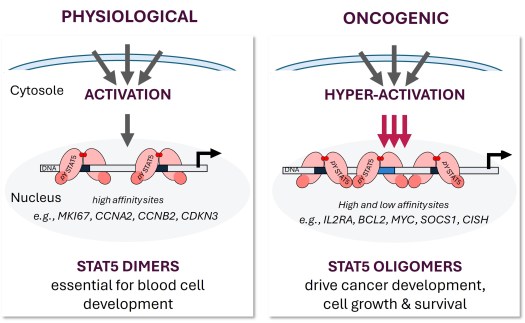
Success of tyrosine kinase inhibitors in the clinics validated the advantages of targeted therapies. However, there are multiple targets thoroughly described in the literature as potent oncogenes, which are not yet addressed. Among other reasons for these targets being untargeted, are challenging PPI. A big class of such PPI belong to the proteins that are oncogenes only in certain conformations (e.g., oligomers) and are essential proteins in others (e.g., dimers) and therefore need to be selectively targeted. However, we managed to develop a phenotypical screening system to address these oncogenic conformations.  

STAT5 – good AND bad transcription factor

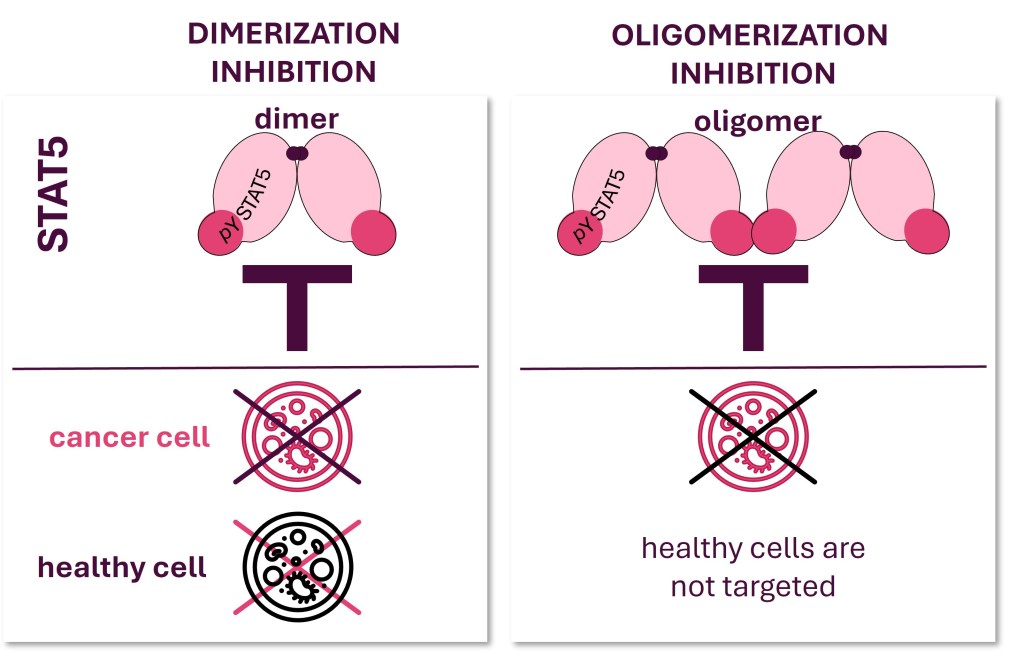
The approach of selectively targeting specific oncogenic PPI has been challenging in drug discovery so far. We developed and protected a unique cell-based phenotypic screening system that faithfully allows screening for inhibitors to disrupt such PPI. The technology was used to screen a chemical library and successfully identified STAT5B oligomerization inhibitors that we aim to develop further in RIANA.

Targeting such oncogenic PPI (e.g., oligomerization of STAT5B) is a novel, highly innovative approach toward the development of potent and safe medicines for the treatment of hematopoietic and other cancer types. Due to the nature of this highly selective anti-cancer therapy, we expect significantly less side effects while maintaining adequate efficacy.